Tokamak Integrated Modeling
We built a tokamak integrated modeling framework for consistent, end-to-end physics calculations across devices ranging from small university tokamaks to ITER-scale systems and industrial pilot plants.
NSFsim and the Framework
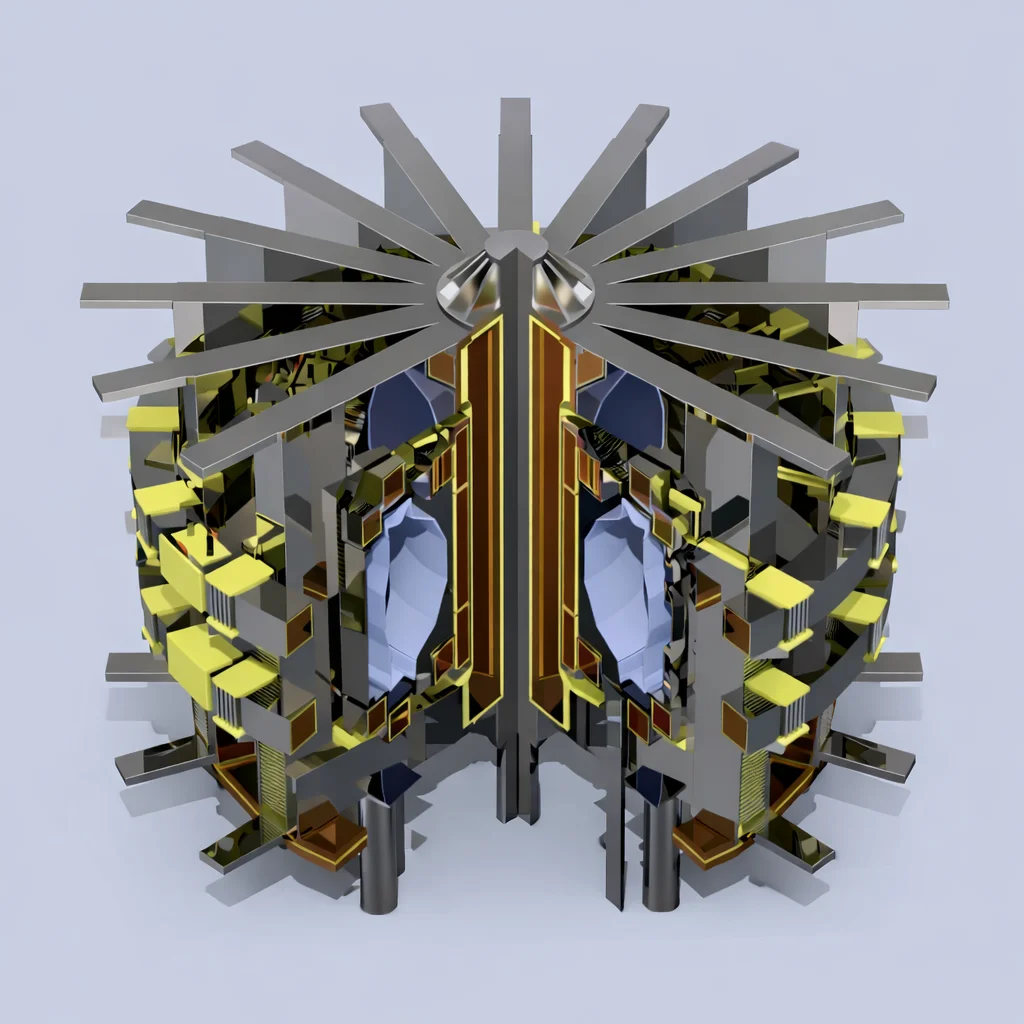
NSFsim is an IMAS-compatible advanced Grad-Shafranov code for 1.5D axisymmetric tokamak plasma simulation. It supports time-dependent transport modeling with free-boundary evolution in external magnetic fields, and builds a tokamak digital replica from the device's magnetic system and conducting structure characteristics.
Capabilities include direct, inverse, and plasma-free calculations; discharge scenario development; disruption and VDE simulation; equilibrium reconstruction; and synthetic diagnostics. NSFsim has been verified many times and validated against other simulation codes and experimental data from many tokamaks.
NSFsim is available on the Fusion Twin Platform, https://fusiontwin.io, for DIII-D, ISTTOK, NSF NTT, SMART, and other tokamaks, with a public web API and Python and MATLAB examples on GitHub.
NSFsim sits at the core of an integrated framework coupled with TRAVIS (ECRH/ECCD ray-tracing), ASCOT5 (NBI and fast-particle physics), TGLF (turbulent transport), and MISHKA (neural network surrogate for the pedestal), enabling validated end-to-end predictive simulations across the full tokamak lifecycle.
Services
- Tokamak physics, design, and operation. Expert support across all phases of tokamak conceptual design, engineering integration, commissioning, and experimental operation.
- Integrated modeling. Development and deployment of own integrated modeling framework that couples 2D Grad-Shafranov and 1D transport solver with first principle transport models, heating and current drive, scrape-off-layer and divertor plasma, and MHD, enabling multi-physics, time-dependent scenario analysis with consistent inputs and outputs across codes.
- Disruption modeling (including 3D). Simulation of plasma disruptions and other off-normal fast events, including three-dimensional effects relevant for runaway electrons, halo currents, electromagnetic loads, and mitigation strategy assessment.
- SOL, divertor, and plasma-material interaction modeling. Simulation of edge plasma phenomena, divertor physics, and plasma-wall interaction, with particular emphasis on liquid lithium plasma-facing components.
- Control-oriented modeling and software-in-the-loop infrastructure. Development of physics-based models and reduced-order representations exposed via Python and web API to support software-in-the-loop validation of plasma controllers.
- Machine learning for physics acceleration and control. Application of modern machine learning methods to surrogate modeling of expensive physics codes, disruption prediction and classification, control policy learning and optimization, data-driven augmentation of transport and edge models, with tight coupling to physics-based simulations for interpretability and robustness.
Tokamak Design
Project vision and scope clarification
Feasibility study and pre-conceptual design
Conceptual design and engineering



Relevant Reading
We use NSFsim and the framework around it for a wide variety of tasks, including tokamak feasibility study and design, solving difficult optimization and prediction problems, developing conventional and training ML-based real-time controllers of plasma shape, position, and other parameters, including multi-objective optimization of control.
Model Verification Using NSFsim: Plasma-free (Vacuum) Calculations
Collaboration with the CREATE team (University of Naples Federico II) on verifying NSFsim against their validated digital replica of the EAST tokamak using plasma-free vacuum shots.
Blog ↗NSFsim Perspective on Disruptions in Tokamaks — Part II: Simulations for DTT
This post extends our disruption analysis work to the DTT device, using NSFsim to simulate Major Disruptions and Vertical Displacement Events and compute the resulting electromagnetic loads on the structure.
Blog ↗NSFSim Perspective on Disruptions in Tokamaks — Part I: Physics Basis
Collaboration with the DTT project (led by ENEA) on disruption analysis, using NSFsim to simulate Major Disruption (MD) and Vertical Displacement Events (VDE) to inform mechanical load assessment.
Blog ↗Next Step Fusion Negative Triangularity Tokamak: Preliminary Design
Preliminary design of the NSF NTT device (R=1m, A=3.75, Ip=0.75MA), covering POPCON analysis, coil configuration, vacuum vessel geometry, and power supply requirements — all developed using the NSFsim integrated modeling framework.
Paper ↗Validation of NSFsim as a Grad-Shafranov equilibrium solver at DIII-D
NSFsim is validated against DIII-D across five plasma shapes — Lower Single Null, Upper Single Null, Double Null, Inner Wall Limited, and Negative Triangularity — confirming accurate reproduction of plasma shape, poloidal flux, and simulated diagnostic signals.
Blog ↗Next Step Fusion Negative Triangularity Tokamak Conceptual Design
Conceptual design of the NSF Negative Triangularity Tokamak — a compact research device for testing ML-based plasma control, from key parameter selection to magnetic system design.
Ready to Get Started?
Tell us about your device and modeling needs and we'll propose a workflow that fits your team and timeline.
Get in touch