THOR Magnetic Field Sensor
A graphene-on-SiC Hall sensor measuring the absolute magnetic field under FPP neutron flux and temperature.

What it is
Continuous, accurate, real-time magnetic field measurement is essential for control and safety in any MCF device. Inductive coils measure only field changes and drift over long pulses, and today's steady-state Hall sensors degrade under FPP neutron flux and heat. THOR is a solid-state Hall sensor: a single atomic layer of epitaxial graphene on radiation-hard silicon carbide, measuring the absolute field instantaneously, with an intrinsically low neutron-damage cross-section and self-healing, built for D-T fluences of 1020–1022 cm−2.
What you get
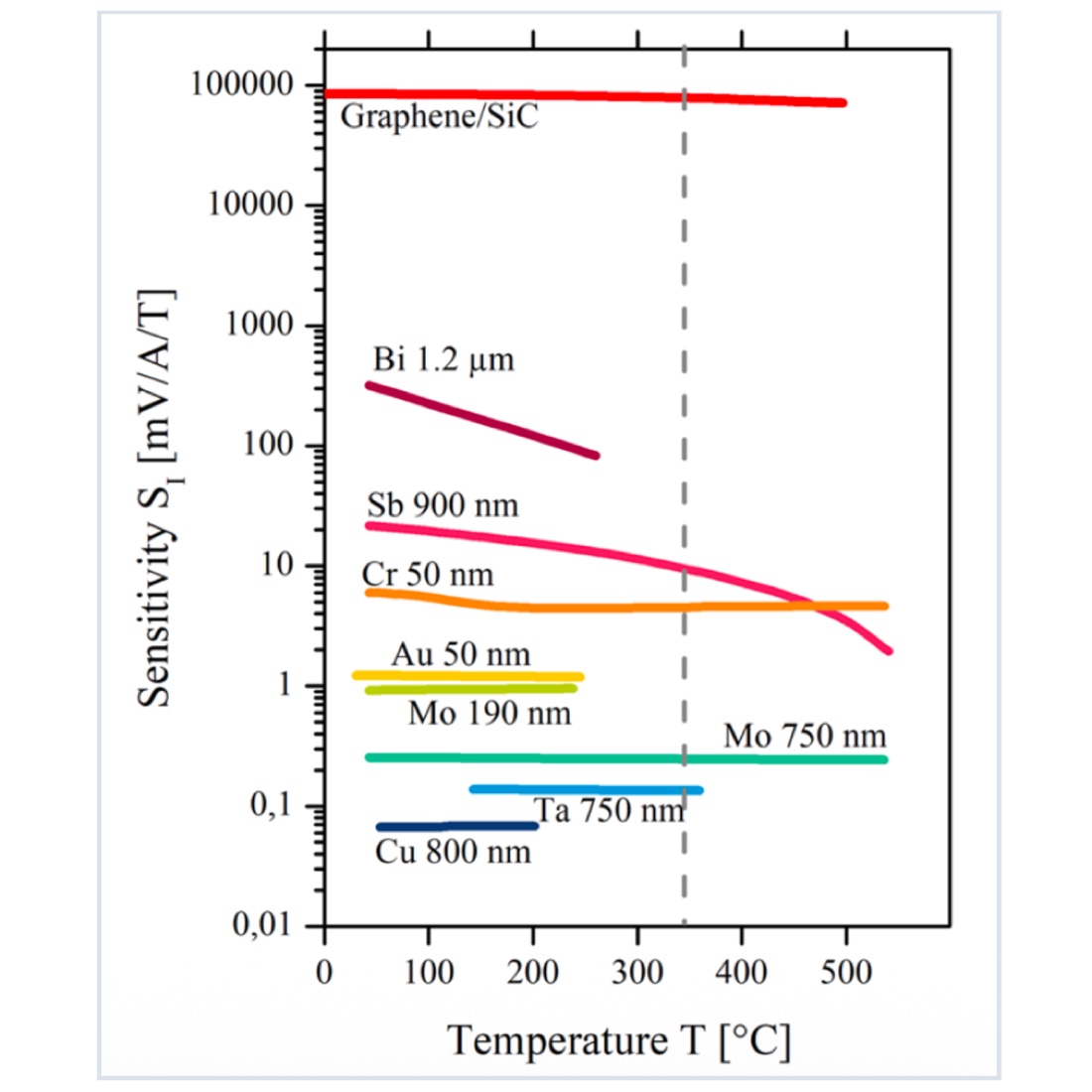
- Sensitivity of ~75 V/AT, 75–80× above the metal Hall sensors used in fusion today
- Absolute field instantaneously, stable to 770 K: no time integration, no drift over long pulses
- Self-healing: neutron damage recovers after a simple thermal anneal at 623 K
- Compact: a 1.4 mm × 1.4 mm sensing chip, for places where magnetic sensors could not fit before
- Sensor placement optimized with our synthetic diagnostics and design tools: the most information from the fewest sensors
How it works
A Hall element: current through the graphene layer and a voltage across it give the field normal to the chip, with no integration and no drift. Solid state, vibration-insensitive, and directly implantable in the vessel. We integrate THOR with our data acquisition and deliver validated field data to plasma control and safety systems.
Proof
THOR is developed with Łukasiewicz – Institute of Microelectronics and Photonics (Poland) under the EUREKA Network Programme, in a consortium we co-founded with COFFEEBPM and Poznan University of Technology. The sensor is validated in a relevant laboratory environment (TRL 4): sensitivity, thermal stability to 770 K, and self-healing after fast-neutron irradiation are published in Applied Surface Science, IEEE Electron Device Letters, and Carbon Trends. The first sensors have arrived in Luxembourg and testing units for MCF devices are in assembly. Demonstration on relevant devices (TRL 6) is planned for 2027, as the magnetic diagnostics layer of our Modular Diagnostics Platform.